


A Strategy the Whole Team Can See is an essay on strategy vs goals for leadership teams leaving a planning cycle with a deck full of approved projects. It shows the signs of a strategy that is really a budget, the choices that turn that deck into a strategy, and the Strategic Intent Board, a one-page canvas William Haas Evans first designed in 2017 and has refined in workshops since, which puts those choices on one wall.
Strategy vs goals is a question for any leadership team choosing what to fund. A goal names a result the team wants, and the difference decides whether an approved deck can guide anyone's work.
A planning season can end with a new deck and no change in the work
Many strategy decks we review are lists of goals. Confusing strategy with goals often begins in the annual planning season. Advisers interview the senior leaders, collect last year's funded projects and this year's new requests, and arrange both into a presentation. Town halls follow. Boxes on the org chart are redrawn, objectives are written, and budgets are set aside for the initiatives that fit. After all that effort, the organization often goes on working as it did before, and the choices that would change the work stay unmade.
Weak execution showed up at three companies in five when researchers surveyed employees of more than 1,000 organizations in 2008. In those companies, most respondents did not agree that important strategic and operational decisions in their organization turned quickly into action. Unclear decision rights and poor information flow mattered most in that survey. Strategy content sat outside the survey's scope. In our experience, a strategy that makes no choices adds a separate weakness: people have no shared basis for deciding what to stop.
Strategy vs goals: a goal names an outcome, and a strategy says how to overcome what stands in the way
"We will be number one in our market" is a goal. That goal tells nobody what to do next week. A strategy starts from where the team stands today, names the difficulty or opportunity in front of it, and commits the team to a way of responding.
When leaders ask us "What is a strategy?" we answer with the kernel of a strategy: three parts, each leaning on the one before. A diagnosis comes first: an honest account of the situation that singles out what makes progress hard. A guiding policy follows, the approach the team picks for that difficulty, and picking it puts many attractive options off the table. Then come a few actions that reinforce one another, each with people and money committed to it and, in our work, a named person with the authority to act.
The diagnosis gives the policy something to answer, and the policy gives each action its reason, so people can see which work fits. When the actions fall short, the team revises the diagnosis, the policy or the actions. A deck that skips the diagnosis reduces its actions to a list.
A list of each executive's priorities is often a budget in disguise
A common kind of bad strategy, in our experience, is a list assembled from the key goals of each senior leader who reports to the chief executive. Each goal may be sound on its own. Placed on one page, the goals can conflict: two initiatives may count on the same engineers, one leader's growth target may depend on a market another leader has proposed leaving, and nothing says what to drop when money runs short. A list like that works as a budget: it records which projects were approved and funded and goes out under the title of strategy.
We often see such a list come together easily, especially in a company with years of earnings growth behind it. As the list grows, the harder question can go unasked: what, in its own situation, is keeping the company from the results it has set for itself?
A list also spares the leadership team an open disagreement. Each leader in the room keeps an initiative on the page. A named obstacle would make some of those initiatives beside the point, and someone at the table would have to say so.
The Strategic Intent Board puts the parts of a strategy on one wall
The Strategic Intent Board is a one-page canvas of eleven boxes, from a team's current condition to its aspiration. I first designed it in 2017 for strategy workshops with executive teams and have refined it in workshops since. The board gives each element its own place, so a leadership team can see which its strategy lacks. I publish it under a Creative Commons license so any team can use and adapt it.
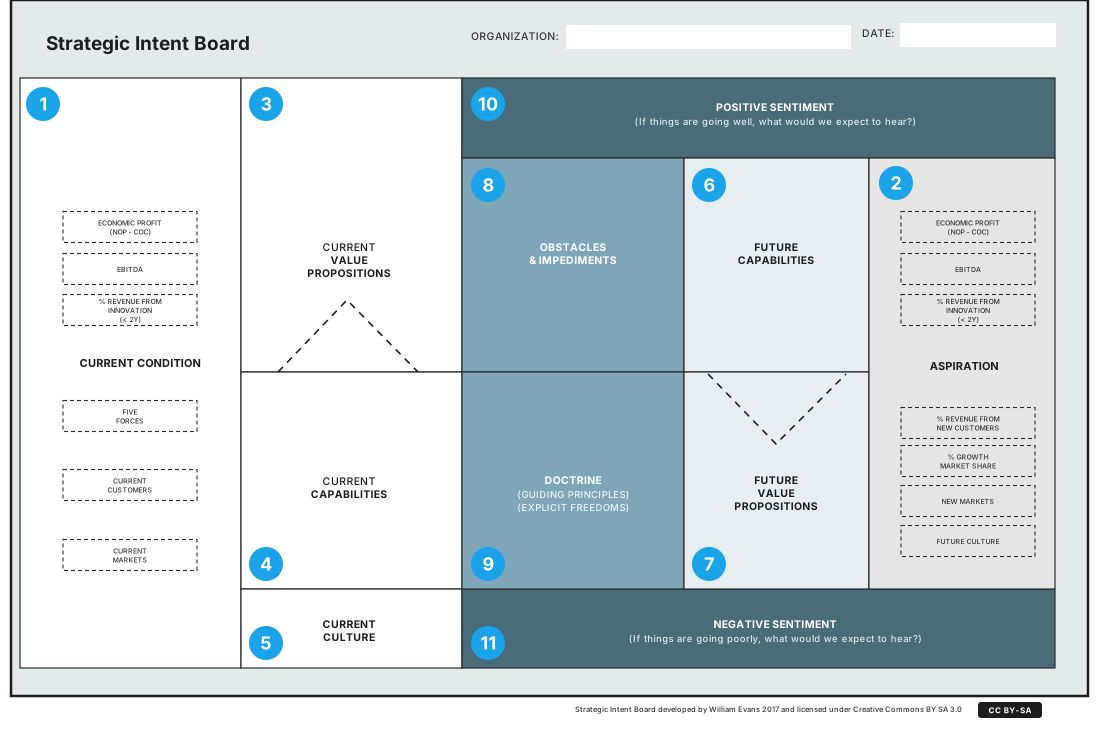
The left half of the board gathers the material for a diagnosis: the current condition with a few hard numbers, the value propositions customers buy today, the capabilities that deliver them and the culture behind how work gets done. The aspiration sits on the right with the measures that will show progress, which is where goals belong. Between the two sides, the team turns that material into a diagnosis by naming the obstacles in its way.
The team then writes its doctrine: the approach it has chosen for those obstacles, with the guiding principles and explicit freedoms people may use without asking permission each time. The future capabilities and value propositions become coherent actions once the team decides what to start, change or retire and staffs and funds the resulting work.
Bands across the top and bottom of the right side record the stories the team expects to hear if the strategy is going well or poorly. Writing those stories down in advance tells everyone which weak signals to listen for. An unexpected story matters too, because it can show what the diagnosis missed.
Every box is filled the same way: people write alone for a few minutes, post their notes, cluster the ones that overlap and choose the few that matter most. In our workshops, a first pass takes about a day.
Comparing written answers shows a leadership team where its members disagree
An organization can hear its strategy often and still have none it can use. In an engagement I described in March 2021, I worked alongside the investment team of a business unit. The unit's president and chief strategy officer had explained the strategy many times, by email, in presentations, at town halls and in one-to-one conversations. Even so, 60% of the organization reported either that no strategy existed or that they could not see what it meant for them.
Each of those channels reaches one person or one audience at a time, and none shows the investment team how differently its members understand the strategy. We asked each member to answer the board's questions alone and unsigned, then put the answers side by side. Once we normalized and combined the responses, agreement on each question came in under 61%. Those differences were where real choosing started. After a few hours of working through them, the team agreed on a draft of its diagnosis, guiding policies, actions and measures and put it before the president for critique. The critique showed that the draft said nothing about an opportunity with a key stakeholder. Agreement in the room made the draft worth critiquing, and the critique made it better.
Goals become useful once a strategy says what they serve
Goals and measures earn their place after the strategy exists. An aspiration can set the direction for a diagnosis, and the measures beside it on the board stay drafts until the team has named its obstacles and chosen its approach. Many planning methods teach the opposite order, goals first and strategy afterward. In our view that order has become orthodoxy, and it still suits a team whose strategy is settled and written down. Once the investment team shared one understanding of its strategy, it could write the objectives and key results its portfolio teams needed. A goal written after the diagnosis can name the obstacle it attacks and the policy it serves, and it can sit within reach of today's capability.
A leadership team can check its own deck with three questions. What obstacle does this strategy name? Which approach have we chosen for dealing with it, and what does that approach exclude? Could someone two levels below us say what the strategy means for their work this quarter and which decisions are theirs to make? A team that can answer all three in a sentence each has the start of a strategy, and a team that answers with each leader's priorities has work to do before this year's budget is set.
The talk The One Thing in the Way: Strategy Design for Organizations in Motion shows how to design a strategy around the one constraint that limits the whole organization. Request a briefing.
Questions leaders ask about strategy vs goals
What is the difference between strategy and goals?
A goal names a result a team would like to see, such as becoming number one in its market. A strategy starts from where the team stands today and names the difficulty or opportunity in front of it. Our working definition has three parts: a diagnosis of that difficulty, a guiding policy for dealing with it, and a few coherent actions with people and money assigned.
How can you tell if your strategy is just a list of goals?
A telling sign is a strategy assembled from the key goals of each senior leader who reports to the chief executive. Placed on one page, those goals can draw on the same people and money, pull against one another, and leave nobody sure what to drop. A list like that records which projects were approved and funded and goes out under the title of strategy.
Why do employees say there is no strategy when leaders have explained it many times?
Email, presentations, town halls and one-to-one talks each reach one audience at a time, so none shows a leadership team how its own members differ. In one business unit, 60% of the organization reported that no strategy existed or that they could not tell what it meant for them. When each member of its investment team wrote the strategy down alone, agreement on each question came in under 61%.
What is the Strategic Intent Board?
The Strategic Intent Board is a one-page canvas that William Haas Evans of Fugue Strategy Advisors first designed in 2017, has refined in workshops since and licenses under Creative Commons Attribution-ShareAlike 3.0. Its eleven boxes record the current condition, the aspiration, current and future value propositions and capabilities, current culture, obstacles, doctrine with explicit freedoms, and the stories a team expects to hear if the strategy goes well or poorly.
References (10)
- William Haas Evans, Strategic Intent Board, first version 2017, refined in later workshops. Licensed under Creative Commons Attribution-ShareAlike 3.0. https://creativecommons.org/licenses/by-sa/3.0/. The board's design, its sentiment bands and the workshop sequence for filling it are original to the author.
- William Haas Evans, "Strategic Coherence: You Can't Hope Your Way to Strategic Alignment," LeadingAgile, 5 March 2021, the source of the investment team account. https://www.liminalarc.co/2021/03/strategic-coherence-you-cant-hope-your-way-to-strategic-alignment/
- Eliyahu M. Goldratt and Jeff Cox, The Goal: Excellence in Manufacturing, North River Press, 1984, for the constraint that limits a whole system.
- Gary L. Neilson, Karla L. Martin and Elizabeth Powers, "The Secrets to Successful Strategy Execution," Harvard Business Review, June 2008. https://hbr.org/2008/06/the-secrets-to-successful-strategy-execution
- Richard P. Rumelt, Good Strategy/Bad Strategy: The Difference and Why It Matters, Crown Business, 2011, for the kernel of a strategy (diagnosis, guiding policy and coherent action), for goals and lists of things to do mistaken for strategy, and for objectives close enough to reach.
- Richard P. Rumelt, "The Perils of Bad Strategy," McKinsey Quarterly, June 2011. https://www.mckinsey.com/capabilities/strategy-and-corporate-finance/our-insights/the-perils-of-bad-strategy
- Gary Hamel and C. K. Prahalad, "Strategic Intent," Harvard Business Review, May to June 1989. The idea of strategic intent behind the board's name.
- A. G. Lafley and Roger L. Martin, Playing to Win: How Strategy Really Works, Harvard Business Review Press, 2013. The aspiration and the capabilities a company must have.
- Stephen Bungay, The Art of Action: How Leaders Close the Gaps between Plans, Actions and Results, Nicholas Brealey Publishing, 2011. Intent with defined freedoms and boundaries, behind the board's doctrine.
- Dave Snowden, "Big Data vs Human Data," keynote, KMWorld 2013, as recorded on 7 November 2013: changing a culture by hearing more stories like some and fewer like others, behind the sentiment bands. https://aboveandbeyondkm.com/2013/11/07/big-data-vs-human-data-kmworld/
William Haas Evans
Founder and chief strategy officer of Fugue Strategy Advisors. He works with leadership teams on strategy design, strategic foresight and organization design. More about William