


Every autumn, executives return to a ritual that rarely changes the year
As summer turns to September, children go back to school with new notebooks and open minds. Their parents go back to the office and to an annual corporate ritual, strategic planning season. We send our children to learn something new, and we gather in conference rooms to repeat planning habits that date to Frederick Taylor and his stopwatch.
From September to November, most large organizations produce two documents. The strategic plan sets out goals, initiatives and targets for several years. The annual operating plan turns the first year into budgets, headcount and quarterly numbers. Both are useful. The trouble starts when the organization treats the two documents as its strategy, and the evidence suggests that many do. When Donald Sull, Rebecca Homkes and Charles Sull surveyed more than 11,000 managers in over 400 companies for the Harvard Business Review in 2015, only about a third of senior managers could name their company's top three priorities. Fewer than one in ten said they could rely on colleagues in other functions to deliver all of the time. The plans had been written, approved and funded, and many of the managers responsible for them could not say what had been chosen.
A plan describes activity, and a strategy makes a choice
Henry Mintzberg put the distinction plainly in 1994: "Strategic planning isn't strategic thinking." Planning is analysis. It breaks a goal into steps, assigns them and measures them. Strategy is synthesis. It joins what the organization knows about its customers, its competitors and its own capabilities into a judgment about where to commit. Mintzberg named three assumptions that make planning fail when it tries to do the work of strategy: that the future can be predicted, that strategists can stay detached from the work, and that a formal process can produce insight.
Roger Martin made the same point from the other side. In "The Big Lie of Strategic Planning" (2014), he described planning as a comfort trap. The real choices, where to compete and how to win, cannot be controlled, and a plan lets a leadership team avoid making them. Richard Rumelt calls the result bad strategy: goals mistaken for strategy, and long lists of things to do in place of a diagnosis of the challenge.
A complex organization cannot be steered by a comprehensive plan
The strategic plan follows the logic of Soviet central planning: decide everything at the center, then measure the organization against the document. The Soviet five-year plans assumed that an economy could be run from the center by planning it in full. The economist Friedrich Hayek explained in 1945 why that assumption fails: the knowledge a plan needs is spread across millions of people and changes faster than any center can gather it. A national economy could not be controlled that way, and neither can a company.
Planning still has a job. A synthesis of two decades of research by C. Chet Miller and Laura Cardinal (1994) found that formal planning is associated with better growth and profitability. Planning earns that result when it serves a strategy the team has already chosen, by sequencing investments, exposing dependencies and checking assumptions on a regular cadence. Mintzberg called this strategic programming. The plan elaborates a strategy and keeps it open to revision.
Name the constraint, see where the current course leads, and commit to one owned action
A leadership team can make planning serve strategy by changing three things this season.
The first is to name the one constraint. Eliyahu Goldratt showed that every system has a single constraint that limits its output more than anything else, and that improving anything else leaves the result unchanged. A plan with forty-seven strategic priorities hides the constraint by spreading money and attention across all of them. The first work of strategy is to name the constraint and test that diagnosis against what the organization actually does.
The second is to see what happens if nothing changes. Before the team commits to anything, it describes the future it is already heading toward if it keeps doing what it does today. In our work with leadership teams, that picture is usually worse than the plan assumes, and it makes the case for acting.
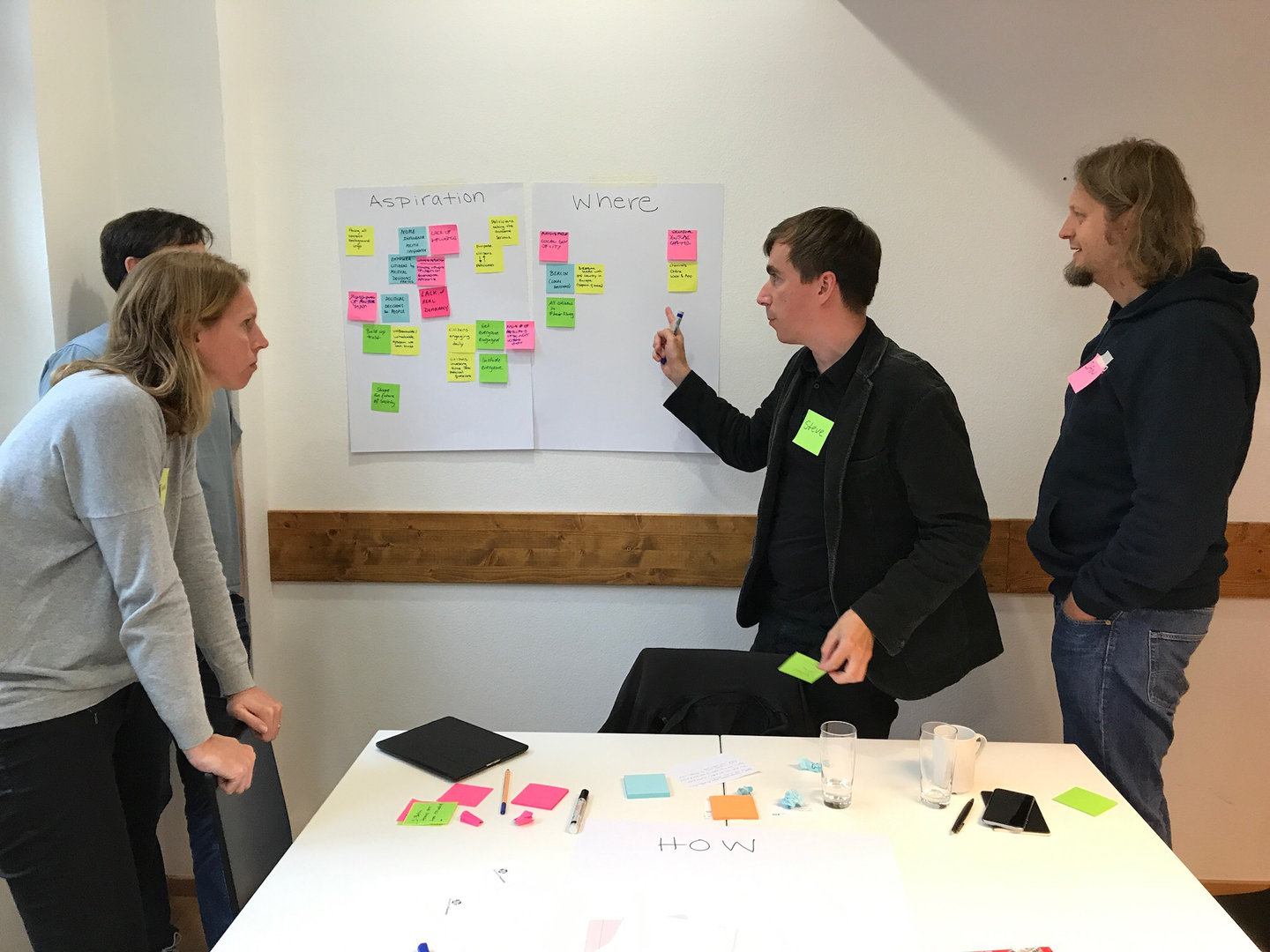
The third is to design one action for Tuesday morning. The team chooses one specific action it will begin next week, with an owner who commits to it in front of colleagues and a date on which the team will look at what happened. The action is designed to change as feedback arrives.
The annual operating plan then funds the action and protects the capacity it needs, and the strategic plan becomes the record of a choice that the next cycle can test.
Children learn because they are willing to be beginners
My five-year-old son is learning to write the letter S. He approaches it as a beginner: he tries, gets it wrong, adjusts and tries again. Try writing an S for the first time with your other hand and you will see how much humility that takes.
Executives could learn the same lesson this autumn. The best time to stop planning and start learning was last year. The next best time is Tuesday morning.
If your planning season produces a document and little change, bring your largest bottleneck to a briefing. The Strategy Design and Its Management Systems workshop takes a leadership team from its constraint to its first action in one day.
The Tuesday action and its tests come from The Pragmatic Strategist, a workshop William Haas Evans and Mike Hyzy co-wrote for the Product Development and Management Association (PDMA) Innovation Summit, Chicago, September 2025.
William Haas Evans
Founder and chief strategy officer of Fugue Strategy Advisors. He works with leadership teams on strategy design, strategic foresight and organization design. More about William
References (7)
- Henry Mintzberg, "The Fall and Rise of Strategic Planning," Harvard Business Review 72, no. 1 (1994): 107–114.
- Roger L. Martin, "The Big Lie of Strategic Planning," Harvard Business Review 92, no. 1/2 (2014): 78–84.
- Richard P. Rumelt, Good Strategy/Bad Strategy: The Difference and Why It Matters (Crown Business, 2011).
- Donald Sull, Rebecca Homkes and Charles Sull, "Why Strategy Execution Unravels, and What to Do About It," Harvard Business Review 93, no. 3 (2015): 57–66.
- F. A. Hayek, "The Use of Knowledge in Society," American Economic Review 35, no. 4 (1945): 519–530.
- C. Chet Miller and Laura B. Cardinal, "Strategic Planning and Firm Performance: A Synthesis of More Than Two Decades of Research," Academy of Management Journal 37, no. 6 (1994): 1649–1665.
- Eliyahu M. Goldratt, The Goal (North River Press, 1984).