
A book for twenty dollars and a computer that could not think
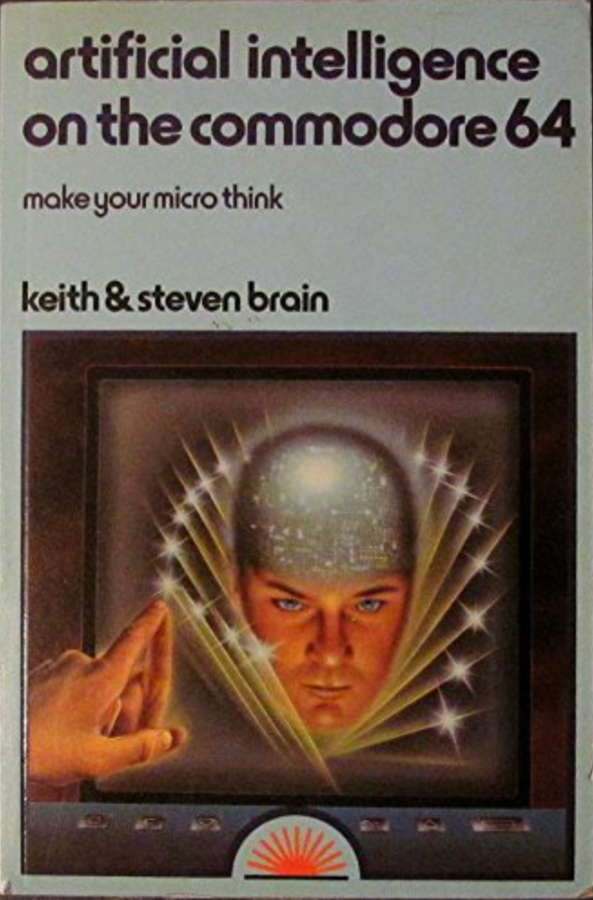
In 1984 I was thirteen, at a computer expo outside Boston with my best friend and his father. At one booth I found a book called Artificial Intelligence on the Commodore 64: Make Your Micro Think, by Keith and Steven Brain. I had twenty dollars in my pocket, and I bought it. For six months I typed hundreds of lines of BASIC into my Commodore 64, trying to teach it to understand a simple sentence. The book was honest about its limits. The ideas were all there: pattern matching, language processing and decision trees. The memory, the data and the computing power were not.
The distance between the idea and the infrastructure has decided the fate of AI ever since. It explains why the field has moved in summers and winters for seventy years, and it is the best guide we have to what comes next.
The first summer promised too much, and taught us what intelligence is not
In 1950 Alan Turing, whose statistical work had helped break the German Enigma cipher, asked whether machines can think. He proposed a test: if you cannot tell whether you are talking with a person or a machine, does the difference matter? Seventy-five years later the question has moved from philosophy into daily life.
The term "artificial intelligence" comes from a 1955 proposal by John McCarthy, Marvin Minsky, Nathaniel Rochester and Claude Shannon for a summer research project at Dartmouth College in 1956. In 1958 Herbert Simon and Allen Newell predicted that within ten years a computer would be the world's chess champion. The founders believed intelligence was the manipulation of symbols, and that building a mind was mainly an engineering problem. Early programs proved theorems and played checkers. They also showed how hard the problem was. Common sense, which a five-year-old uses without effort, would not reduce to rules.
Simon himself saw the limit. His idea of bounded rationality, central to the work for which he received the Nobel Prize in economics in 1978, held that people do not optimize. We "satisfice": we find answers good enough for the time, information and attention we have, using patterns learned through experience. The philosopher Hubert Dreyfus went further in What Computers Can't Do (1972). Drawing on Martin Heidegger, he argued that intelligence comes from practical engagement with the world, and that no list of rules could reproduce it. If you memorized every rule of baseball, you still could not pitch a shutout. Expertise comes from living through thousands of situations until the body knows what to do before the mind can explain why.
The first wave left a lesson we have still not fully absorbed. What looks easy to us, such as recognizing a face, getting a joke or making coffee, is extraordinarily hard for a machine. What looks hard to us, such as chess or proving theorems, is comparatively easy. The roboticist Hans Moravec described this reversal in 1988, and it still catches leaders who judge a task by how hard it feels to a person.
Each winter followed promises the infrastructure could not keep
The first winter came when the promises went unkept. Machine translation produced gibberish, and programs that worked in narrow domains failed on exceptions and uncertainty. After the Lighthill report of 1973, the British government cut most of its funding for AI research, and American defense funding contracted soon after. "Artificial intelligence" became a phrase researchers left out of grant applications.
The lesson for leaders is that hype without delivery destroys credibility, and credibility takes decades to rebuild. Every technology wave has a trough, and the question is whether you build through it or wash out with the tide. In systems terms, overshoot and collapse follow when feedback is ignored and goals drift away from what is actually happening.
The second summer arrived in the 1980s with expert systems, which wrote human expertise down as rules. Digital Equipment Corporation used one to configure computer orders and reported savings in the tens of millions of dollars a year. In 1982 Japan launched its Fifth Generation computing project, and companies built departments around expert systems and bought specialized Lisp machines to run them. By 1987 the limits were plain. Expert systems were brittle, could not learn from experience and needed constant updating by expensive specialists. Cheaper workstations and personal computers made the Lisp machines obsolete, and the market collapsed into a second and longer winter.
The pattern repeats in every wave. A technology that works in the laboratory does not automatically work in the market, and the distance between "it works in the demo" and "it works in production" has swallowed whole companies. That is a systems problem. You cannot add AI to an organization without considering how it meets the people, processes, power, culture and incentives already there.
I learned the cost of being early from the inside
In 1998 I joined Curl Corporation, a company of about a hundred people in Cambridge, Massachusetts, spun out of research at MIT's Laboratory for Computer Science. Curl built a language derived from Lisp to make web applications behave like desktop software, and once again its founders were building intelligent systems, including expert systems for financial applications. The technology was genuinely novel, and we had customers in financial services. We were fighting the battle the expert systems of the 1980s had fought: friction, learning curves and the comfort of tools that were clumsy but familiar. We were asking people to change paradigms when they were content to adjust parameters. When the NASDAQ peaked in March 2000 and the dot-com bubble began to burst, the capital disappeared. The language is still in use in Japan and Korea, and it never brought about the change its founders intended.
I learned that technical elegance does not guarantee adoption, that timing matters as much as invention, and that you can have the right ideas and still fail because the surrounding system is not ready. In the philosopher Alicia Juarrero's terms, you change a system by changing the constraints that govern it, or you wait until they shift on their own.
The long winter built what the next summer needed
From about 1987 to 2012, AI was unfashionable, and researchers called their work machine learning, neural networks or pattern recognition. Beneath the surface the conditions changed. The internet produced vast datasets, contributed willingly by all of us. Computing power kept growing, and graphics processors designed for video games turned out to suit the training of neural networks. Quietly, spam filters, recommendation engines and fraud detection proved that machine learning could make money. The most important work often happens when nobody is watching, and the people who kept working through the winter were in position for the next summer.
In 2012 Alex Krizhevsky, Ilya Sutskever and Geoffrey Hinton won the ImageNet image-recognition competition with a deep neural network, AlexNet, by a wide margin. In 2016 DeepMind's AlphaGo defeated the Go champion Lee Sedol. The theory was decades old. What had changed was the data, the computing power and the methods for training, and the companies that already held data and computing capacity at scale became the AI powerhouses. That produced the winner-take-most market we live with now.
In 2017 Google researchers introduced the transformer architecture in "Attention Is All You Need," and in November 2022 OpenAI released ChatGPT to the public. AI moved from recognizing patterns to producing text, code and images, and the line between tool and collaborator blurred in ways that unsettled people.
Carlota Perez's model places today's boom at a turning point
The economist Carlota Perez has shown that each technological revolution since the Industrial Revolution has moved through two periods. In the installation period, financial capital pours into the new infrastructure, speculation builds into a frenzy, and the frenzy ends in a crash. A turning point follows, in which institutions are rebuilt. Then comes the deployment period, in which the technology spreads through the whole economy and its benefits reach far more people. Perez treats AI as the newest stage of the information revolution that began with the microprocessor in 1971, and she has written that "we seem to be stuck in the installation period."
The present boom bears the marks she describes. Stijn Van Nieuwerburgh of Columbia Business School estimates in the Brookings Papers on Economic Activity that $10.3 trillion will go into the AI buildout from 2025 to 2032, an average of 3.6 percent of US gross domestic product a year. That is about half again the peak share of the railway boom and more than three times that of the internet boom. MIT Technology Review reported in September 2026 about $750 billion of AI spending this year against $150 billion to $200 billion of AI revenue. Productivity has not kept pace. A survey of nearly 9,000 executives in seven countries, published by the National Bureau of Economic Research, found that 78 percent of firms use AI, with almost no net effect on employment and a labor productivity gain of about 0.2 percent a year. In July 2026 South Korea's main stock index fell almost 40 percent from its peak in little more than a month as investors fled AI chipmakers, and in November Nvidia lost more than $470 billion in value over two trading days.
The other signs of a frenzy are familiar. Many enterprise AI projects stall before production. Companies claim capabilities they do not have. The media swing between breathless promise and existential dread, and synthetic media make it easier to fabricate what we see and read. The gains so far have been uneven, as William Gibson's line about the future predicts: "The future is already here. It's just not very evenly distributed." The owners of models, computing infrastructure and proprietary data have captured most of the value.
Some observers see a pause in place of a bubble. In October 2025 the chair of the Federal Reserve, Jerome Powell, said the leading AI companies "actually have earnings," unlike the firms of the dot-com era. Philipp Carlsson-Szlezak and Paul Swartz wrote in Harvard Business Review that "the challenge is not predicting when the bubble will pop." Perez's model does not need a crash date either. A turning point is the period in which the excesses of a frenzy force a change of institutions, and we think that period has begun.
The choices that matter come after the frenzy
Vendors now describe an agentic phase: software that acts on its own to complete multi-step tasks, from scheduling across calendars to researching and drafting reports and running whole workflows. Specialized systems for law, medicine and finance work where the expert systems of the 1980s failed, because they learn from data in place of relying only on hand-written rules. My judgment is that jobs will be reorganized far more than they disappear, and that the consequences of choices made, or avoided, during the frenzy will show in which organizations come through the turning point.
If this is a turning point, the decisions that matter change. During the frenzy the question was who could buy the most computing power. In the deployment period, the value goes to organizations that redesign their work, their decision rights and their institutions around a technology that has become ordinary infrastructure. The infrastructure will outlast any crash, as the fiber laid in the 1990s did. The work for a leadership team is to decide which problems AI should solve, which decisions stay with people, and which processes and constraints must change for the technology to pay.
These choices come with a responsibility. Installation periods concentrate wealth among the owners of the infrastructure, they separate communities with access from those without, and they unsettle politics as capability concentrates in a few companies and countries. They also change culture. John Culkin, summarizing Marshall McLuhan in 1967, wrote that "we shape our tools and thereafter our tools shape us." When AI mediates our writing, research and decisions, the values in its training data and objectives begin to change what we can imagine. The deployment period is when a society decides how widely the gains spread.
The pattern is dialectical
Each wave revealed new possibilities and new limits, and each was usefully wrong. From the 1950s to the 1970s we thought intelligence was the manipulation of symbols, and that error taught us what intelligence is not. From the 1980s to the 2000s we thought it was statistical pattern recognition plus expert rules, and that was usefully wrong too. Since 2012 we have learned that capability emerges from scale, which is partly true and not enough. What comes next probably joins computation with embodiment, context and intention, the things Dreyfus argued mattered in 1972.
Consent requires literacy
AI technologies are powerful, and they are neither wise nor moral. Wisdom and morality are our job, as they always have been. Most people do not yet understand what AI can and cannot do, or the trade-offs they are being asked to accept. Accepting a future you cannot see clearly is acquiescence, and it falls short of consent.
Two literacies close that distance. AI literacy is the ability to recognize AI systems, judge the claims made about them, weigh automation against human judgment, and know when AI is appropriate and when it is dangerous. Futures literacy is the capacity to imagine several possible futures, to ask "what if?" and "why not?", to separate what is inevitable from what is chosen, and to question stories about where technology is "naturally" heading.
My Commodore 64 could not think, and the book I bought for twenty dollars said so plainly. Seventy years of AI suggest that honesty about limits is the best guide through each wave. The future is plural, and which one arrives depends on the choices and investments we make now. The AI in Action evening at Temple Beth El began that conversation in our community, and its field report shares the format for anyone who wants to continue it. If your leadership team wants to test its strategy against several AI futures, request a briefing.
William Haas Evans
Founder and chief strategy officer of Fugue Strategy Advisors. He works with leadership teams on strategy design, strategic foresight and organization design. More about William
References (24)
- Alan M. Turing, "Computing Machinery and Intelligence," Mind 59, no. 236 (1950).
- John McCarthy, Marvin Minsky, Nathaniel Rochester and Claude Shannon, "A Proposal for the Dartmouth Summer Research Project on Artificial Intelligence," 31 August 1955.
- Herbert A. Simon and Allen Newell, "Heuristic Problem Solving: The Next Advance in Operations Research," Operations Research 6, no. 1 (1958).
- Herbert A. Simon, "Rational Choice and the Structure of the Environment," Psychological Review 63, no. 2 (1956).
- Hubert L. Dreyfus, What Computers Can't Do: A Critique of Artificial Reason (Harper & Row, 1972).
- Hans Moravec, Mind Children: The Future of Robot and Human Intelligence (Harvard University Press, 1988).
- James Lighthill, "Artificial Intelligence: A General Survey," Science Research Council, 1973.
- Alicia Juarrero, Context Changes Everything: How Constraints Create Coherence (MIT Press, 2023).
- Alex Krizhevsky, Ilya Sutskever and Geoffrey E. Hinton, "ImageNet Classification with Deep Convolutional Neural Networks," Advances in Neural Information Processing Systems 25 (2012).
- David Silver and others, "Mastering the game of Go with deep neural networks and tree search," Nature 529 (2016).
- Ashish Vaswani and others, "Attention Is All You Need," Advances in Neural Information Processing Systems 30 (2017).
- Carlota Perez, Technological Revolutions and Financial Capital: The Dynamics of Bubbles and Golden Ages (Edward Elgar, 2002).
- Carlota Perez, "What Is AI's Place in History?", Project Syndicate, 11 March 2024.
- Carlota Perez, "A long delayed golden age: or why has the ICT 'installation period' lasted so long?", UCL Institute for Innovation and Public Purpose blog.
- Stijn Van Nieuwerburgh, "Financing the AI Buildout," Brookings Papers on Economic Activity, Fall 2026.
- David Rotman, "What's at stake in AI's trillion-dollar gamble," MIT Technology Review, 15 September 2026.
- Yotzov, Barrero, Bloom, Davis and others, "Firm Data on AI," NBER Working Paper 34836, 2026.
- Reuters, "South Korea's stock market plunges as AI-driven boom fades," 29 July 2026.
- Reuters, "Nvidia selloff deepens, adding to AI jitters," 10 November 2026.
- Jerome Powell, press conference, Federal Reserve, 29 October 2025, as reported by Fortune.
- Philipp Carlsson-Szlezak and Paul Swartz, "The Questions You Should Be Asking About the AI Bubble," Harvard Business Review, 11 September 2026.
- John M. Culkin, "A Schoolman's Guide to Marshall McLuhan," Saturday Review, 18 March 1967.
- William Gibson, as quoted on NPR's Talk of the Nation, 30 November 1999.
- Keith Brain and Steven Brain, Artificial Intelligence on the Commodore 64: Make Your Micro Think (Sunshine Books, 1984).