
A board game taught innovation teams what a lecture could not
In December 2025 I spent a day with a group of innovation teams who needed to get better at delivery. I could have stood at the front of the room and lectured for four hours. We played a board game instead. The getKanban simulation asks teams to run a small software company through a quarter of product development in about four hours. Teams compete against one another. They make real prioritization calls, hit real bottlenecks and watch the financial results of their choices arrive a few rounds later. When a team changes its strategy, it sees what the change does to its standing against the other tables.

About two hours in, something shifts in every session I have run. The teams build the muscle memory of how to collaborate, decide and deliver together. They stop thinking about principles. They start feeling the physics of flow.
Discipline about flow is what makes discovery possible
Many leaders believe operating discipline kills innovation. They see process as the enemy of creativity, and they expect discipline to slow a team down. My experience runs the other way. The most innovative teams are the ones obsessed with how work flows. They care about how they work together, they build systems, they measure what matters and they remove friction every day. That foundation is what makes speed possible, and speed gives a team more chances to notice the thing nobody planned for. Serendipity needs a system to flow through.
Other fields learned this long ago. Nick Saban built his Alabama football program on what he called the Process: preparation, and doing your job on every single play. The championships came out of years of operating discipline. Navy SEALs rehearse each mission until the mechanics become instinct, so that when chaos arrives they have options and they have been there before. In every field I have worked in, operational excellence creates the conditions in which novelty, insight and learning can emerge.
Six practices let an innovation team see its flow and improve it
The first practice is to map the system. Draw how work travels from an idea to value in a customer's hands, and mark where it moves and where it sits. A team cannot improve a flow it cannot see.
The second is to make the work visible. A board works as an information radiator that gives the whole team the same picture. Problems surface early, course corrections happen quickly and conflicts get settled as they happen.
The third is to limit work in progress. A limit on work in progress reveals where the system is already slow. The bottlenecks it exposes were there before anyone set the limit.
The fourth is to remove waste. Every handoff adds friction, every approval queue adds delay and every context switch adds cost. Lean thinking asks the same question over and over: what can we eliminate?
The fifth is to manage to outcomes. The measures that matter are changes in customer behavior and business value delivered. Counting features shipped tells a team very little. Managing to outcomes requires an economic model clear enough to make trade-offs that favor the value of the whole portfolio.
The sixth is to build cross-functional teams with real accountability. A team that owns an outcome from end to end can make decisions without asking permission.
Expertise lives in the body, so it has to be practiced
The philosopher Hubert Dreyfus spent decades showing that expertise cannot be learned as a set of rules. Rules give a beginner a place to start, and they fall away as skill grows. An expert has lived through thousands of situations until the body knows what to do before the mind can say why. A master woodworker responds to the grain and the resistance of the wood in front of her. Dreyfus, drawing on Martin Heidegger, called this skillful coping. We learn by being thrown into situations and dealing with them, and what we learn becomes part of how we see and how we move.
Reading about flow is like reading about hammering. You can memorize Little's Law, which says the average amount of work in a system equals the rate at which work arrives multiplied by the average time each item spends there. You can pass a test on it. You do not know it until you have watched work pile up on your own board and felt your lead time stretch. Michael Polanyi described how a tool becomes part of the person using it: when we drive a nail, we attend to the head meeting the nail and stop noticing the handle in our palm. That is why pilots train in simulators, surgeons practice before they operate and Alabama runs the same plays thousands of times before Saturday.
A simulation lets a team live through a quarter of consequences in an afternoon
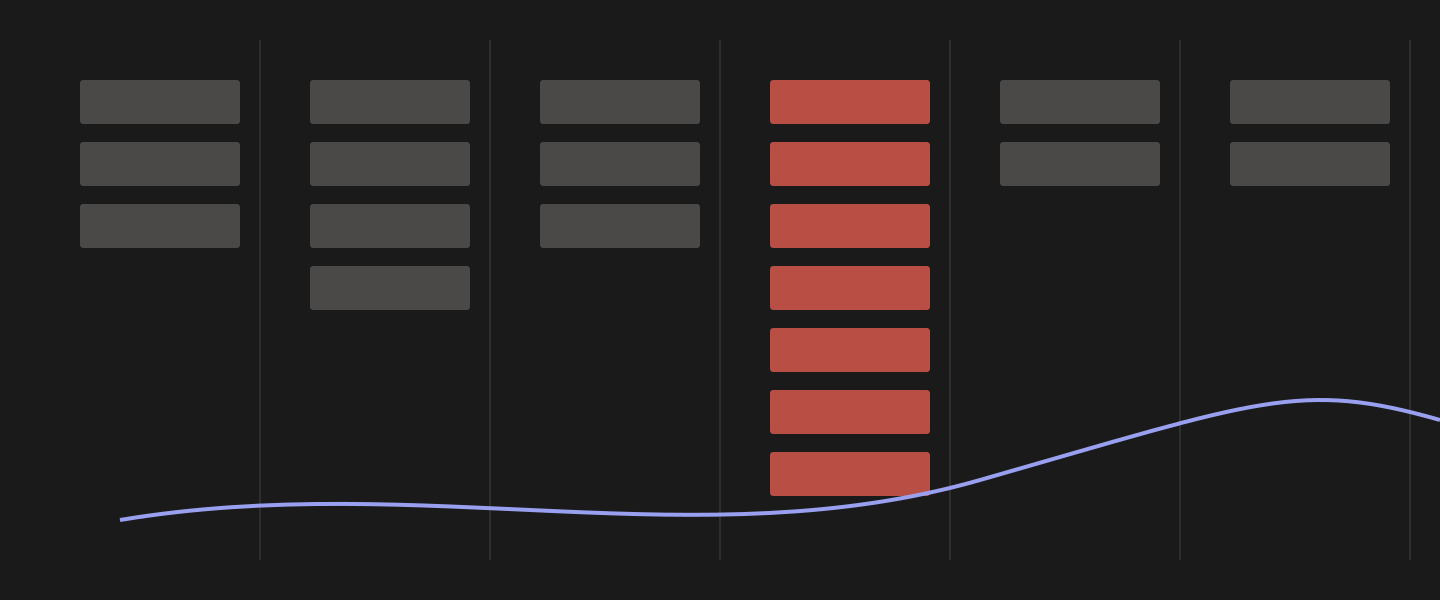
In four hours, teams live through a quarter of delivery decisions. Their cumulative flow diagram shows a bottleneck forming. Their lead time jumps when they ignore the limits on work in progress, and the spread of their lead times widens across the chart. They calculate the revenue they lost when a piece of work sat waiting on a dependency because they sequenced it badly. After a while the board, the dice and the rules fade from attention. What remains is a team dealing with a situation, deciding, feeling the result and adjusting.
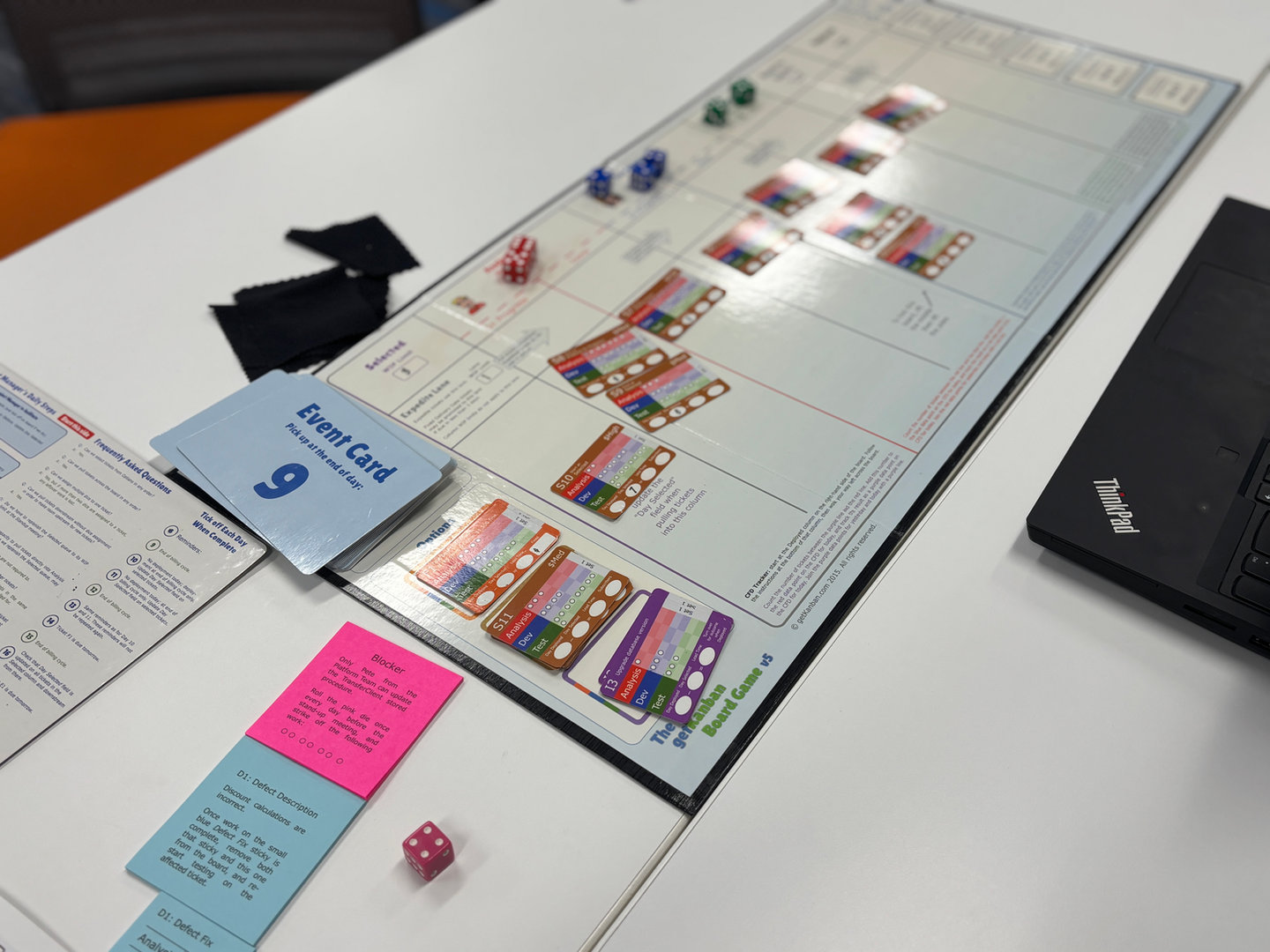
Then it clicks. The team stops following a method and starts to understand how work works. They will recognize the patterns in their real delivery work. They will feel a bottleneck forming before the metrics confirm it. They will know when to swarm and when to stay in their lane, and they will make trade-off calls with confidence because they have already lived the cost of getting them wrong.
Tight operations free people for the work only people can do
Innovation depends on an operating foundation that lets a team move fast without breaking things while it experiments with real feedback loops. The best innovation teams I have worked with visualize their work, limit what is in progress, measure what matters, settle trade-offs with economic models and remove friction from their value stream every day. They treat operational excellence as the source of their speed. When operations run well, people are free to do what humans do best: solve hard problems, delight customers and build things that matter.
William Haas Evans
Founder and chief strategy officer of Fugue Strategy Advisors. He works with leadership teams on strategy design, strategic foresight and organization design. More about William
References (5)
- Hubert L. Dreyfus and Stuart E. Dreyfus, Mind over Machine: The Power of Human Intuition and Expertise in the Era of the Computer (Free Press, 1986).
- Martin Heidegger, Being and Time (1927).
- Michael Polanyi, Personal Knowledge: Towards a Post-Critical Philosophy (University of Chicago Press, 1958).
- John D. C. Little, "A Proof for the Queuing Formula: L = λW," Operations Research 9, no. 3 (1961).
- getKanban board game, getkanban.com.