
The Real Story - How a category killer got built, told by the merchant who built it
Updated: May 24

The official history of The Sports Authority credits one man with a vision. That version is wrong, the tidy story we reach for because it is easier to tell than the truth. Its founding merchant, Roy Cohen, kept the real one, and it is the better lesson in how strategy actually emerges. The chain that became the first sporting goods retailer to pass a billion dollars in sales was built far less from a plan than from judgment.
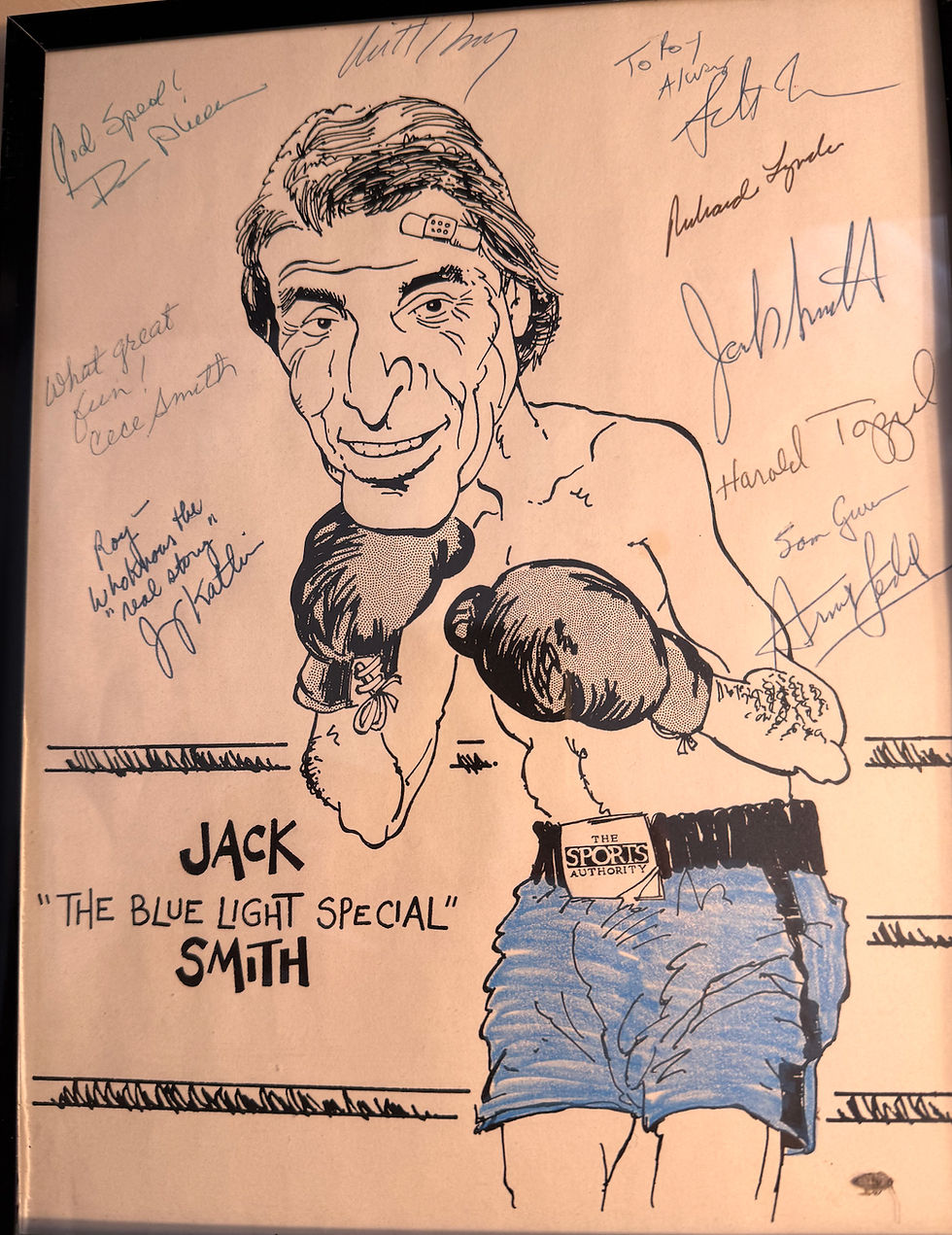
“to Roy, who knows the real story.” — inscribed on a closing dinner memento, March 1990
Roy Cohen and I work out at the same gym. We see each other a few times a week, and sometimes we get to talking. Jazz, retail, family, strategy, work, in that order.
Both of us are big on Monk. Roy’s chocolate Labradoodle is named Jazz. When I came by to talk through the story behind this piece, Ray Charles was on the speakers, Genius + Soul = Jazz, and the dog kept trying to climb into the conversation.
A few years back Roy told me about the series he wrote in 2011, The Real Story. The title came from a memento he was given at the closing dinner when The Sports Authority sold to Kmart in March 1990. One of his partners had inscribed it, “to Roy, who knows the real story.” He wrote the five posts two decades later because, as he put it, sometimes the real story is more interesting than the myth.
The merchant in the room
Most people who shopped at The Sports Authority never knew its origin, only its scale. It became the first full-line sporting goods chain to pass a billion dollars in annual sales, and at its height the largest sporting goods retailer in the country, with more than four hundred stores. The format it pioneered, the forty-thousand-square-foot sporting goods superstore, is one nearly every American has walked. None of that was certain in the founding years, when the company was still just a room full of people who did not yet know it would work.
Roy was a founding executive, the senior vice president and general merchandise manager. The GMM is the merchant. The role decides what the stores carry, in what depth, at what price, from which vendors, at what margin, and builds the buying organization that makes those calls every day. In big-box retail the merchandising function is the engine. Real estate, operations, and finance all exist to put the right goods in front of the customer, and the merchant decides what right means.
The founding team was small, and it turned over fast. Jack Smith would come in as chief executive, Roy as chief merchant. The first head of operations was Dick Carter, who lasted only through the build of the first store, and the first head of finance was Chet Howard, who lasted a few months past opening before moving to run information technology and then leaving. Richard Lynch eventually settled in as chief financial officer and Arnold Sedel as head of store operations, but the original lineup was already being recast before the doors opened. The whole thing was backed by a syndicate of venture firms led by William Blair.
The myth is the one that gets told about almost every company. A founder sees the future, raises the money, executes the plan, and wins. In this version Jack Smith conceived a sporting goods empire and willed it into being. It is tidy, and it is wrong. The plan the team pitched to investors looked almost nothing like the company that sold to Kmart three years later. A different person was supposed to run it. It had a different name. It had a different pricing strategy. The things that became iconic were not in any plan at all. The real story is what happened in the gap between the two, and that gap is where the useful lessons live.
It did not even begin with Jack Smith. The idea of a large-format sporting goods store came from a supplier. Jory Katlin, then an executive at Maurice Sporting Goods, one of the largest wholesale distributors in the industry, brought the concept to the venture investor Scott Meadow. Katlin could not run the company himself. A distributor that sold to the whole industry could not also own the chain that would compete with its customers, the same conflict the new store would later have to talk its own suppliers through. So he took a passive seat on the board instead, and it was Katlin who first contacted Bob Mead as the prospective chief executive. The vision, in other words, did not start with the visionary the myth assigns it to. It started with a supplier who saw the shift coming and knew he could not be the one to lead it.
Roy’s five posts read, to me, as a study in emergent strategy, the term Henry Mintzberg and James Waters gave to the idea that the strategy a company actually lives is mostly discovered in action rather than set in advance (Strategic Management Journal, 1985). Five patterns in his account hold up as durable principles, and they are easiest to see stated plainly first.
One, you sharpen judgment by owning your misses, not burying them. Two, the plan is the stage, and the strategy is what gets played on it. Three, the team is part of the strategy, and the people with the capital decide who leads. Four, a strong name commits you to a position the merchandise then has to make true. Five, reinventing a category means hiring the experience you do not have. Taken together they describe a company composed in the playing, not the planning. His words, from the blog and from our conversations, carry the rest.
Lesson One
You sharpen judgment by owning your misses, not burying them
Roy opens the series with a confession, not a triumph. In 1985 a headhunter called him about a chief merchant role at a new chain, and he turned it down without an interview. He could not picture it. Office supplies back then meant legal pads, accounting paper, pens, and paper clips.
“I couldn’t visualize the breadth of assortment that would fill a superstore.” — Roy Cohen, in conversation
Personal computers existed, but in his mind they belonged in an electronics store, not next to the man selling legal pads. The chain was Staples, which became one of the defining superstore successes of the decade.
Twelve months later the sporting goods version of the same idea crossed his desk, and he committed inside a day. The pattern had not changed. His read of it had. Home Depot and Toys R Us had already proven the category-killer format, the giant single-category store that wins on selection and price, and now Staples was proving it too. The market had handed him the proof he had lacked the year before.
He puts it plainly in the blog. He tries to never make the same mistake twice.
But the deeper move is what the sharpened eye then saw. The Staples miss had taught Roy to stop thinking in categories and start thinking about customers, and that shift had a specific origin. Roy ran merchandising at Child World, the castle-fronted toy chain that was the second-largest in the country and Toys R Us’s chief competitor, a six-hundred-million-dollar business that knew the category-killer format from the inside. There he had worked on a superstore concept that never got built, one meant to carry everything for a child rather than just toys. The project died. The idea did not.
“I’m not focusing on a particular category. I’m focusing on the customer.” — Roy Cohen, in conversation
Pointed at sporting goods, that single shift designed the store. Not a deeper baseball aisle or a wider rack of fishing rods, but everything a sports enthusiast or the parent shopping for one might want, under a single roof. The format was not a flash of genius. It was a pattern carried over from a failure, by a merchant whose eye had been sharpened by owning a miss. Pattern recognition under uncertainty is not a gift you are born with. It is the residue of misses you were willing to claim.
Lesson Two
The plan is the stage, and the strategy is what gets played
The plan the team carried into the investor meeting in Chicago in December 1986 had a chief executive named Bob Mead, a placeholder name, Warehouse of Sports, a promotional pricing strategy built on constant sales events, and a set of financial projections. Almost none of it survived.
The projections did. In Part 5 Roy writes that they projected the first store to do an annualized volume of around $8.7 million, when the average sporting goods retailer did about $1.7 million, and people in the industry thought they had lost their minds. The first store did $10.5 million.
Everything else changed. By 1990 the chief executive was Jack Smith, not Bob Mead. The name was The Sports Authority, not Warehouse of Sports. The pricing strategy was everyday fair pricing, steady honest prices rather than a calendar of promotions, which was Roy’s position and the opposite of what the plan proposed. The brand’s voice was the comedian Louie Anderson. The visual signature was an open ceiling painted blue. Not one of those four was in the Chicago plan.
This is what most realized strategy actually looks like up close. The plan that gets a company funded is rarely the strategy it ends up running. The plan is the stage. It puts the players in position and gives the money a reason to be in the room. The strategy is what gets played once the music starts, discovered through three years of decisions no plan anticipated.
Roy thinks this way because he learned music this way. As a boy he was taught to improvise at the piano by the bandleader who had taught his mother. The man did not hand him pieces to memorize. He gave him the chords and the structure and showed him how to find his own way through. Here are the tools, he would say, now play what feels right. A jazz musician does not abandon the chart. The chart is what makes the freedom legible. The strategy works the same way. Structure first, then play.
Lesson Three
The team is part of the strategy, and the people with the capital decide who leads
The decisive moment of the whole founding had happened back in that Chicago room. The lead investor, Scott Meadow of William Blair, ran it. Roy presented the merchandising plan and sketched the store on a whiteboard, soft goods in the middle, hardlines around the walls, a wide racetrack aisle to keep people moving. The merchandising went well. The numbers went well. Then the proposed chief executive, Bob Mead, stood up to speak.
The way Roy described it to me matches Part 2 exactly. It was obvious the moment Mead opened his mouth that he was not a leader. He was old school. He had no concrete ideas beyond repeating what others had said, and when asked a direct question, he struggled to answer.
The deal died in that room. Not over the concept, which the investors liked. Over the man who was supposed to lead it.
What happened next is the part the myth leaves out. Scott Meadow went to work behind the scenes to find the leader the deal needed. Roy described him to me as the one who pulled the right band together, the producer who knew the music was good and went looking for a bandleader who could front it. Meanwhile Roy’s involvement had leaked back to his employer, who made a strong counteroffer to keep him. He gave Meadow a deadline, the first of February, and when the deal had not come together by then, he told them never mind, he was staying. Only in March did it come back to life.
It came back because Meadow had found his bandleader. Jack Smith had run sporting goods at Herman’s and had been chief executive of another retailer in the same corporate family. He was an operator, not a merchant, but the investors believed he carried the credibility the round needed. Roy, who had wanted the top job himself, asked why not him. The answer, which he reports in Part 3, is the cleanest statement I know of how venture deals actually work.
“Because this is the guy who can get it financed.”— The Real Story, Part 3
The capital did not pick the best merchant. It picked the leader the money could believe in, which is not always the same person. Roy took a deep pay cut, anchored the merchandising himself, and spent three years building the company through steady, productive friction with the man who got the seat he had wanted. At the closing dinner in 1990, the investor and board member Mitt Romney captured the partnership in a backhanded toast, presenting Roy with a pair of heavy-duty knee pads for all the times he had pushed his initiatives through over Jack’s objections. The wrong leader kills a sound concept. The right pairing ships, friction and all.
Lesson Four
A strong name commits you to a position the merchandise then has to make true
TThe name was an accident that became a strategy. The agency, W.B. Doner, walked in with presentation books titled AllSport, Roy’s own placeholder, because they had nothing better. The night before the pitch, one of their creatives had walked past a Port Authority sign at La Guardia and brought in The Sports Authority as a surprise. Jack hated it. His objection, as Roy tells it in Part 4, was the cost of putting that many letters on a sign.
He came around only after he floated the name to his weekend golf foursome and all three of them told him it was the best name they had ever heard. Peer validation did what the strategy argument could not. The gap between his two reactions is the whole lesson. The first read priced the sign. The second read priced the strategy.
Naming is positioning, and positioning, in the sense Al Ries and Jack Trout gave the word, is the act of claiming a distinct place in the customer’s mind (Positioning: The Battle for Your Mind, 1981). A name that claims nothing holds no place. AllSport excludes nothing. Every sporting goods retailer could say it sells all sport, so the word does no work and commits the company to nothing.
The Sports Authority excludes things. Not Sports Amateur. Not Sports Discounter. Not Sports Warehouse. Authority is a posture, and a posture is a public promise made before the strategy has been proven. Once that word is over the door, every decision underneath it has to make it true.
For a merchant, the position does not stop at the sign. It runs straight down into the assortment, the product line, the allocation, and the pricing. Authority means carrying more depth in each category than a specialty shop, which sets the assortment. It means a line that runs from opening price points to the premium brands a serious athlete respects, which sets the product range. It means the defining brands have to be on the wall in every store, not just the flagship, which sets allocation, the decision of how much of each product goes where. And it means prices that read as fair and confident rather than as a discounter’s. The name wrote a check. Assortment, line, allocation, and price had to cash it.
So Roy built depth no specialty store could match, and pushed the assortment ahead of the culture rather than trailing behind it. He added bicycles, which had lived in specialty shops and which no sporting goods store carried.
“No, a bike is a sport.” — Roy Cohen, in conversation
Rollerblades and scooters came in as they crossed from hobby to sport. He leaned hard into soccer with Umbro just as soccer was arriving in America, and rode the fitness boom when every customer wanted Reebok. The discipline underneath is knowing when to enter a category and when to leave one, and you only learn that by reading the culture in real time.
Authority also meant choices that cost money. Around 1988, well ahead of the industry, the store stopped carrying assault-style rifles. By Roy’s recollection that was close to a fifth of the gun business, given up on purpose. A name that means something forces decisions like that. Saying yes to a position means saying no to revenue that does not fit it.
The clearest proof of the principle is the place the merchandise failed the claim. The team never visited Nike. In Part 4 Roy is blunt about it. They did not travel to Nike in Oregon because Nike had only begun to grow and seemed, on the surface, like it would not be a problem. “Oh, but we were wrong,” he writes. As best we understand it, the cost was not a missed introduction. It was a hole in the assortment exactly where the Authority claim was loudest, the brand that was about to become the brand, thin on the wall, and with it the lost co-op advertising support, the money a vendor puts toward a retailer’s ads, and the early-partner allocation priority that went to competitors instead. You can commit to a position with a name. You only hold it if the merchandise, including the one brand you talked yourself out of chasing, delivers.
Lesson Five
Reinventing a category means hiring the experience you don’t have
The myth ends at the strategy. The real story is mostly about building the merchandising organization that ran it. In the summer of 1987 Roy was working out of an old Radio Shack storefront in a dead mall. As he tells it in Part 5, on the first day his assistant asked where the typewriter was, and there wasn’t one yet.
From there, in a matter of weeks, he had to build a buying team, the buying disciplines, the vendor terms, the assortment plan, and the pricing, while the computer system was still being installed. His own depth was hardlines, the bats and balls and tackle. So he built his first team of buyers from four different retail backgrounds, including a department store veteran for the apparel and footwear he knew less well.
A team drawn only from sporting goods would have produced more of the same.
The category architecture came out of those four sensibilities arguing in one room. A new format demands more experience than any one person holds, so you hire the experience you lack, on purpose, before the gaps show up on the shelf. It is the same instinct as casting a band. You do not hire four of the same player. You hire the ones who together can play music none of them could play alone.
The same earned judgment shows up in the small calls, where a resourceful team under a tight budget kept turning concessions into signatures. Anthropology has a word for making do with what is at hand, bricolage, which Claude Lévi-Strauss used for the improviser who builds from whatever the moment provides, and which Karl Weick later carried into the study of how organizations improvise their way to distinctive outcomes under pressure (Organization Science, 1998). The Sports Authority is full of it.
Start with the shopping carts. The store would have them, over Jack’s objection that carts were too warehouse. Roy held the line, because the point was to move people through the whole store and let them fill a cart, not grab one thing and leave. Then the open ceiling, which ran across the early stores. It was not a design choice. It was a budget choice. From Part 5, the existing ceiling stayed exposed and painted blue because finishing it white would have cost an extra twenty thousand dollars a store. There was no money, so it stayed, and then Roy saw what it could be.
The brand’s voice came the same way. The Louie Anderson campaign that defined the chain for years had first been written for John Candy, who proved too expensive. So they cast a then little-known Louie Anderson, who became well known shortly after. In both cases the conventional choice, a finished white ceiling, a famous star, was ruled out by the budget, and the substitute turned out more distinctive than the safe option would have been. The white-ceiling store would have looked like every other sporting goods store. The Candy campaign would have leaned on a familiar face and faded.

Not every change was a happy accident. The biggest physical departure from the warehouse concept was deliberate, and it was about apparel. A pure warehouse, with goods massed on round racks, would have told the apparel and footwear suppliers that the store was a discounter, and those vendors guard their brands against that. So the apparel area got carpet under proper fashion fixtures rather than goods piled on racks. The point was to convince the suppliers, and the customer, that this was also a fashion retailer, not just a bulk seller of hard goods. Softlines were the most profitable part of the business. Winning the brands that filled them required looking like a store worthy of them, which is the same lesson as the name. The position has to be made true in the room, not just claimed on the sign.
That is bricolage, and it is what an experienced eye does with a constraint. The constraint was real and restrictive. What it did was force a substitution, and the substitution surfaced an option more distinctive than the obvious one. Before you optimize a budget concession out of the system, ask whether the substitute might be the better answer. A good share of the brand’s identity came from substitutes the team first took for bad news.
The music is what you make
Less than three years after the first store opened, with the chain still under a dozen stores, Kmart bought the company for seventy-five million dollars. The projection had held. Almost nothing else from the original plan had. The plan got the money in the room and the band on the stage. Everything that made the company work was discovered in the playing.
Even the famous projection was less a forecast than a dare. Roy had backed into the $8.7 million figure category by category, knowing the inventory turns he needed and what the big-box operators in other categories had already proven was possible. It was, as he put it, an educated guess and also a requirement, because if the store did not do that volume the model did not work. So they overspent on marketing on purpose, with the investors’ blessing, to build the brand fast enough to make the number real. That is closer to what Gary Hamel and C. K. Prahalad called strategic intent, an ambition set deliberately beyond current means so the whole organization has to stretch to reach it (Harvard Business Review, 1989), than to anything a forecast would produce.
Which returns us to the music playing the day we talked. Ray Charles made Genius + Soul = Jazz by taking the standards everyone knew and finding something of his own inside them, the chart in one hand and the freedom to depart from it in the other. That is what Roy did with a company. He had the structure, the merchant’s disciplines earned the slow way over decades, and he had the nerve to play against it when the moment asked for something the plan did not contain. You can only play like that if you have earned the judgment to know what feels right. When I asked him where good decisions come from, he did not reach for a framework.
“Judgment comes from experiencing things, from doing things. It’s a real-world thing.”— Roy Cohen, in conversation
That is the part no plan supplies and no shortcut replaces. The myth tells you what was decided. The real story shows you the judgment that did the deciding, and judgment, like jazz, is learned only by playing.

A note on sources
Roy Cohen’s five-part series, The Real Story, is the primary source for his account and for quotations attributed to the blog: Part 1, Part 2, Part 3, Part 4, and Part 5. Quotations attributed to conversation come from interviews the author conducted with Roy in 2026. Details of the founding, the founding executives, the venture syndicate led by William Blair, the November 1987 opening in the Fort Lauderdale area, the March 1990 sale to Kmart for seventy-five million dollars, and the chain’s later scale as the first full-line sporting goods retailer to exceed one billion dollars in sales are drawn from the public record, including company histories published by FundingUniverse and Encyclopedia.com.
References
Henry Mintzberg and James A. Waters, “Of Strategies, Deliberate and Emergent,” Strategic Management Journal 6, no. 3 (1985): 257–272.
Gary Hamel and C. K. Prahalad, “Strategic Intent,” Harvard Business Review, May–June 1989.
Al Ries and Jack Trout, Positioning: The Battle for Your Mind (New York: McGraw-Hill, 1981).
Claude Lévi-Strauss, The Savage Mind (Chicago: University of Chicago Press, 1966), on bricolage.
Karl E. Weick, “Improvisation as a Mindset for Organizational Analysis,” Organization Science 9, no. 5 (1998): 543–555.


Comments